”Come Find Me” a Documentary by Noriflorentina Vito

This film depicts an authentic journey of the heart.

A very brave woman searches for answers as she seeks to uncover the truth about her adoption from Romania and to find her birth family.

Following the Romanian Revolution of 1989, Western media uncovered approximately one hundred thousand abandoned children living in institutions where death, disease and abuse were the norm.

Parents from countries such as England, Ireland, America, Canada, Germany, Australia and New Zealand, travelled to Romania to adopt these children in the hope of giving them a better life.

In the early 1990’s, there were estimates of approximately 1,000 children a week being adopted internationally.

Many of these children were not orphans but were abandoned by their parents due to poverty. 

The surge in International Adoptions led to widespread unethical practices, corruption and human trafficking.

In response, the Romanian government implemented stricter adoption laws and regulations and subsequently introduced a ban on International Adoptions in 2001.

This ban was lifted in 2005, but the process of International Adoption from Romania is long and complex and restricted to couples where one of the couple is Romanian or single women who are Romanian. 

Link to watch the story below:

https://www.pbs.org/video/come-find-me-bz3tpj/

Children of Decree 770. by Adele Rickerby

This is what happened in Romania when Abortion was banned.

Photo of an abandoned child in a cot in the Institute for the Unsalvageables located in Sighetu Marmatiei, a town in Transylvania at Romania’s Northern border with Ukraine. 1992. Copyright, Thomas B. Szalay photography.

On the first of October, 1966, Nicolae Ceausescu enacted Decree 770, which caused untold suffering for the women and children of Romania.

Decree 770 declared abortion and contraception illegal, except for women over forty-five, women who had already borne four children ( later raised to five), women whose lives would be in danger if their pregnancy were to go full-term, and women who had conceived through rape or incest.

In 1966, the population of Romania was approximately nineteen million. With decree 770, Ceausescu’s aim was to increase the population to thirty million by the year 2,000, in the belief that population growth would lead to economic growth. By 1976, the population had increased to approximately twenty-one million. An increase of about two million or twelve percent.

Women of child-bearing age were subjected to monthly gynaecological examinations to monitor a pregnancy or ensure that an illegal abortion was not carried out.

There was a monthly tax on childless people twenty-five years and over, married or not.

Any doctor convicted of performing an illegal abortion faced a jail term of between ten to twenty years. Despite this, illegal backyard abortions took place, sometimes resulting in sterility, infections and even death.

During these dark days of Communism, thousands of babies were abandoned by their impoverished parents into State-run institutions. After Ceausescu and his wife, Elena were executed by firing squad on Christmas Day, 1989, journalists from around the world descended on Romania and discovered the horror of these institutions. Approximately one-hundred thousand children had been abandoned in these institutions, where children were malnourished, neglected and physically and sexually abused.

Children born during this time were called ”Decretei”, children of the Decree. Decretei comes from the Romanian word ”Decree” meaning ”Decree”.

Empty shop shelves and queues for food were common during Communist era Romania. Lack of food meant malnourished mothers gave birth to premature and underweight babies. Hospitals fed these babies intravenously with unscreened blood. Hypodermic needles were in short supply and used over and over again without proper sterilisation. As a result of which more than ten thousand babies were infected with H.I.V causing an epidemic of A.I.D.S.

Once a baby or child had been abandoned into a hospital or institution, it was uncommon for biological parents to visit on a regular basis or to take their child back home.

thepromisekept.co is my facebook page where I share posts to the global community about Non Government Organizations working on social justice issues such as; child abandonment, poverty, education, and human trafficking.


Thirty Years On, Will the Guilty Pay for the Horror of Ceausescu Orphanages?

”Courtesy of Guardian News and Media Ltd.”


By 1989, when the dictator was killed, up to 20,000 had died in Romania’s children’s homes. Now criminal cases may finally be held and those responsible for these deaths, brought to justice.

They were the pictures that, for many across the world, were the defining image of the aftermath of Romania’s 1989 revolution: emaciated children clothed in rags, looking into the camera with desperate eyes amid the squalid decay of the country’s orphanages.

Christmas Day will mark 30 years since Nicolae Ceaușescu, Romania’s megalomaniac, isolationist dictator, was convicted in an impromptu trial and shot dead together with his wife. His execution ended more than two decades of rule that brought poverty and misery to the majority of the country’s population.

In the three decades since his fall, only a handful of people have faced legal punishment for their roles in Ceaușescu’s repressive regime, and there have been no criminal cases over the tens of thousands of children mistreated by the regime’s inhumane network of juvenile internment institutions.

The country’s orphanages began to fill up from the late 1960’s when the State decided to battle a demographic crisis by banning abortion and removing contraception from sale.

Many of the children in the orphanages were abandoned by parents too poor to look after them.

The most horrific abuses took place in orphanages for disabled children, who were taken away from their families and institutionalised. At the age of three, disabled children would be sorted into three categories; curable, partially curable and incurable. Across the country, there were twenty-six institutions for category three disabled children. Investigators from the Institute picked three to investigate and found shocking mortality levels amongst the children. Seventy percent of the registered deaths were from pneumonia. There is testimony of children suffering from frostbite, of children literally being eaten by rats, being kept in cages or being smeared in their own faeces.

The list of those being prosecuted for the deaths is classified.

Alex Kuch; How International Adoption Changed My Life

Happy Birthday in the Family

Elgard Andreas, four years old.

Just a few years ago, Romania started a dirty and illegal business; they banned the adoption of the children abandoned by irresponsible people and put them in the hands of other irresponsible people!

At the age of four weeks after birth, I was abandoned at the No.4 Children’s House in Lugoj, Timis County. I was born on July 6, 1994, in the city of Jimbolia, Timis. My mother, Lili, wanted to get rid of me- she had postpartum. Mama, (Liliana’s mother), gave me to the children’s home.

At Lugoj, a Danish foundation annually organised a series of visits to families in Denmark, who wanted a child. I was one of the lucky ones in the project. I was admitted to a family in Copenhagen, the Elgard Jensen family, both employees of the Royal Danish House. The family had two sons, one of whom was a student in medicine. A very beautiful family who started my adoption. I was four years old. I knew that I was going to be theirs. I knew that I was going to be Danish. I wanted to get rid of the 120 kids in that ugly house, dirty and administered by bad people who beat me for no reason.

I was deluded. A family promised. I was sure that I would be adopted. I was in the courthouse or in the courtroom. I do not know exactly. I was asked if I wanted to be adopted by Eva and Flemming. I said my first ”da” and they took me out of the room. After a few minutes, I was told to return to Lugoj for a while. It was a short time because in December 1999 I was visited by the Herbold family from Germany who wanted to open a family home in Checea. They got me in their house. It was very nice. It was hot and I had food and I did not have to hurry when I ate. I could sleep without being touched by the older boys and I said for the first time, ”mother”. Unfortunately to a person not worth it.

At Checea, the Children’s Safety Foundation in Romania became my home. It became the place where I feel safe and appreciated for what I do.

I am twenty-four years of age. I graduated from the Social Assistance Faculty and I only have six months to complete the dissertation. I want to study more. I decided that after graduating the Mastership, I will enrolled in the PhD.

In 2017, helped by two friends, we set up an ong; YouHub Association, and in December 2017, I was elected President of the Institutionalised Youth Council, the national representation of children abandoned in Romania.

My mission is to promote and protect the rights of the child. Adoption is a fundamental right through the right to family. The Romanian government, encouraged by a Baroness, blocked International adoption on the grounds that it had become organ-trafficking. Checks, inquiries, and other inquiries and …nothing!!

I don’t understand Tiriac’s involvement in this story! But one thing is certain. Romania boasts about 57,000 abandoned children. 19,000 in children’s homes.

Are we a statistic or are we people who could change our story if we were supported towards an independent, dignified and better life.

In January, Adoption Law should be discussed in the Chamber of Deputies, was voted unanimously in the Senate. I hope that the article on the reopening of International Adoption from Romania is voted for and so gives the chance of a family to all abandoned children.

https://andreaselgardjensen.ro/2019/01/02/la-multi-ani-in-familie/

Deaths in Siret Horror Orphanage.

Siret is a town situated in Suceava County, North-Eastern Romania, only two kilometres from the border with Ukraine.  It is an isolated place; ideal to hide away children not considered ”normal”. In the 1980’s, during the Communist era, Siret was home to 2,000 orphaned, sick and abandoned children.

Criminal complaint for the death of 340 children, in the Siret horror orphanage, during communism. Valentin Nas shared the link.

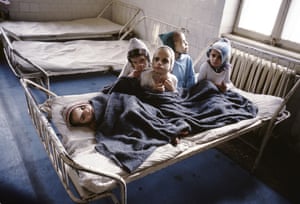
The image of the children in the Siret Orphanage is from the personal archives of Ronald Federici.

BY FLAVIA DRĂGAN | Updated: June 25, 2018 – 5:21 PM

The Institute for the Study of Communist Crimes (IICMER) has filed a complaint with the Attorney General’s Office concerning the inhumane treatment of orphaned children confined in the Siret Hospital for Children with Chronic Neuropsychiatric Condition (HCCNC). 340 children died there between 1980 and 1989.

IICCMER has denounced the deaths which occurred in the last decade of the communist regime. The largest number of deaths, 81 children, was recorded in 1981.

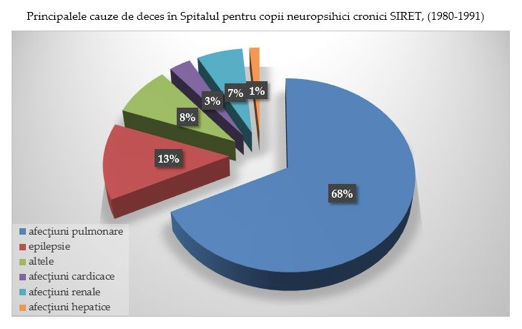
According to IICCMER’s statement released to the editorial, most children died of illnesses that could be treated, and for most of them the deaths were caused by the inhumane way they were treated in the orphanage. A very large number of children have died during winter, most of them due to pneumonia, epilepsy, heart, kidney, and liver diseases.

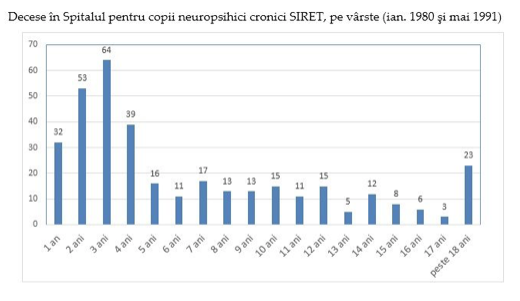
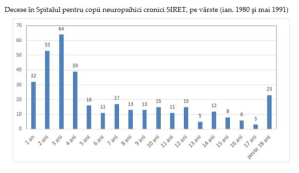
Figure: Deaths in the Siret HCCNC, by age (Jan. 1980 through May 1991)
SOURCE: IICCMER

Most children died when they were between one and four years old. Many of the children admitted to the Siret orphanage were from Suceava County, but also from Bucharest, Bihor, Timiş, Dâmboviţa, Constanţa.

Figure: Evolution of deaths in the Siret HCCNC (1980-1991)

“Following the analysis of death documents and death certificates, carried out by IICCMER experts and by a team of forensic pathologists, we have found that, on the one hand, there were increased mortality rates in the case of easily preventable or early diagnosable and properly treatable pathologies, and, on the other hand, there were deaths that support, by their very nature, our conclusions regarding the existence of a regime characterized by inhumane treatments applied to minors in the hospital.”

309 employees at the hospital-orphanage in 1989

The HCCNC was operating under the Ministry of Health and was headed by a doctor/manager appointed by order of the minister. Since its inception in 1956 until 1991, the hospital has been administered by nine doctors, and the last of them has been running the hospital-orphanage for 24 years.

At the end of the 1980s, the orphanage included 14 specialist doctors, 109 nurses, 115 auxiliary staff, 12 administrative staff, 12 staff runing the school and 47 workers.

There is a legend that hundreds of children were left to die in a field.

Since the establishment of the hospital-orphanage in 1956 until 2001, 1,500 children have died of the total of 8,886 children who have been placed in the Siret institution.

After the death of 81 children in 1981, the number of deaths fell in 1982 and 1983 following the management’s decision to transfer out a very large number of children.

Figure: Main causes of death in the Siret HCCNC (1980-1991)
– Pulmonary affections 68%
– Epilepsy 13%
– Others 8%
– Heart conditions 3%
– Kidney problems 7%
– Liver problems 1%
SOURCE: IICCMER

Among the staff who worked at Siret HCCNC during the communist era there is a legend of an order coming from the Communist Party leadership regarding the fast release from hospital of a large number of patients, an order which was quickly executed at the end of November 1983. The hospital register has recorded the transfer of 750 children over just a few days at the end of November 1983. According to former employees, a large number of these children, especially those with unknown parents, have never reached their transfer destinations, being instead isolated on a field and left to die without being registered.

IICMER states that it could not confirm the information, but it continues the checks.

Criminal complaints to follow for the period 1956-1980

IICCMER said it would file criminal complaints for inhumane treatments for the period 1956-1980, but “given the high volume of work, we can not predict when the actions will materialize,” the Institute’s spokeswoman added.

Last summer, IICCMER has filed another criminal complaint with the Attorney General’s Office for the inhumane treatment of children hospitalized in the Cighid, Păstrăveni and Sighetu Marmaţiei home-hospitals. 771 children have died there from 1973 to 1990. In that case, the prosecutors from the Attorney General’s Office have started in criminal investigations.

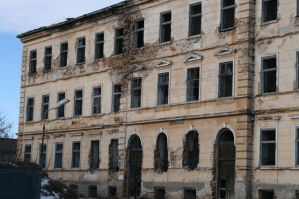
Credit photo: Monitorul de Suceava; photo of the Orphanage Building.

Half a Million Kids Survived Romania’s Slaughterhouses of Souls- Now They Want Justice

Dec.28th. 2015. Global Post by Vlad Obelescu

https://www.pri.org/stories/2015-12-28/half-million-kids-survived-romanias-slaughterhouses-souls-now-they-want-justice


Nicolae and Elena Ceauşescu in the midst of children and youth who addressed New Year 1978 wishes to party and state leaders. (30.XII.1977)

[Photo #BA225] Online Communism Photo Collection.

Romania’s Lost Generation- Inside the Iron Curtain’s Orphanages


Girls eating lunch at a Romanian Orphanage. Photo courtesy of Tom Szalay.

http://www.abc.net.au/radionational/programs/allinthemind/inside-the-iron-curtain’s-orphanages/5543388


Romanian Adoptee Defies The Odds To Complete A Degree

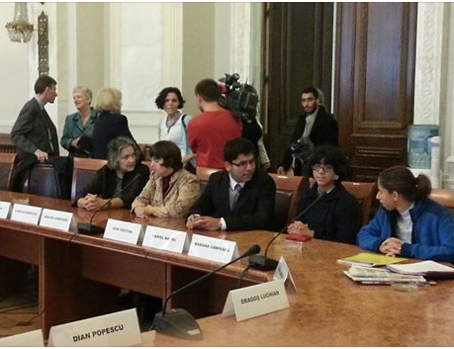
Alex was only eighteen years of age when he made his first trip to Romania to speak to the Parliament to advocate for the reopening of International Adoptions from Romania.

When Romanian orphan Alex Kuch was adopted at age two, his new family was told he would never finish high school or lead a normal life.

This week, Alex finished his final semester of a Bachelor of Arts degree in Politics and International Relations with a minor in Sociology at the University of Auckland.

Now 23-years-old, Alex is an established children’s rights advocate and is invited to speak around the world. Next month, he will co-present research into the experiences of adoptees at a major international conference in Canada.

“My parents weren’t going to let a prediction determine who I was going to become,” Alex says. “While never pushing me, they always encouraged me to give my best in everything I did. My family is really proud, especially as I’m the first person in my family to go to university. I’m really looking forward to using my degree in the real world.”

Alex will be one of the youngest presenters at the sixth International Conference on Adoption Research in Montreal and has received a grant from the University of Auckland’s Vice-Chancellor’s Student Support Fund to attend.

His research, completed with Dr Rhoda Scherman from AUT, analyses the stories of other adoptees shared on the New Zealand-based I’m Adopted website.

“The stories have helped us to pull together the common themes of what adopted children go through. It’s valuable knowledge for agencies and families, for example knowing when to intervene or what to expect, and to provide better support.”

Alex was adopted in 1997 from an orphanage in Cluj- Napoca, Romania by a German couple. He also has a younger brother adopted by the same family. The family moved to New Zealand in 2006.

At the time of his adoption, a German psychologist advised Alex’s family that the emotional damage from spending his formative years in an orphanage meant he would never lead a normal life, complete high school, or have the social skills to integrate into society.

“The conditions weren’t the greatest. My parents were told that I had started to rock backwards and forward due to a lack of emotional and physical stimulation and I could not look people directly in the eyes.”

Alex received specialist support such as speech and fine motor therapy, and against all odds, has now completed high school and university.

“It was challenging, however the University of Auckland has been very supportive. I had a writer for exams as I still have some fine motor challenges. Also many of my assignments were tailored to reflect my advocacy work.”

Alex is passionate about lobbying the Romanian Government to re-open international adoptions, which were closed in 2001.

In an unusual twist, Alex met his birth mother on live television during a lobbying trip to his birth country. While speaking on a talk show about his adoption experience, producers blindsided him by bringing his birth mother and half siblings onto the stage.

Alex is now concentrating on his long-term aspiration is to establish a children’s rights consultancy that collaborates with different sectors to have a positive impact on the wellbeing of children.

In October Alex will speak in Brussels at the third Asia-Europe Foundation Young Leaders Summit on children’s rights and international adoptions.

Danelle Clayton | Media Adviser
Communications Office
Email: d.clayton@auckland.ac.nz