La mulți ani, în familie!

Screen Shot 2020-03-16 at 07.13.21

La mulți ani, în familie!
În urmă cu doar câțiva ani, România a început o afacere jegoasă și ilegală!
A interzis adopția copiilor abandonați de niște oameni iresponsabili și ajunși pe mâna și la mila altor oameni iresponsabili!
Eu, la vârsta de 4 săptămâni după naștere, pe care o regret uneori, am fost abandonat la casa de copii nr 4 din Lugoj, județ Timiș. M-am născut la data de 6 iulie 1994, în orașul Jimbolia – Timiș, ea, Lili, a avut postpartum, a vrut să scape de mine. Măsa (mama Lilianei), m-a dat la casa de copii.
La Lugoj, o fundație daneză organiza anual o serie de vizite la familiile din Danemarca care își doreau un copil de sărbători.
Am fost unul dintre norocoșii acelui proiect. Am fost primit la o familie din Copenhaga, familia Elgard Jensen, ambii angajați ai Casei Regale Daneze.
Aveau doi băieți, unul student la medicină iar celălalt student la drept. O familie foarte frumoasă, care a dorit să mă înfieze.
Au început demersurile pentru adopție, aveam 4 ani, știam că voi fi al lor, știam că voi fi Danez, îmi doream să scap de cei 120 de copii din casa aia urâtă, murdară și administrată de oameni răi care mă /ne băteau fără motive serioase!
Am fost amăgit, mi s-a promis o familie, eram sigur că voi fi adoptat. Am fost în tribunal sau la judecătorie, nu știu exact, am fost întrebat dacă vreau să fiu adoptat de Eva și de Fleming, am spus primul meu DA hotărât, apoi m-au scos din sală.
După câteva minute mi s-a spus că mă întorc la Lugoj, pentru o perioadă.
Așa a fost, o perioadă scurtă pentru că în decembrie 1999 am fost vizitat de familia Herbold, din Germania, ei doreau să deschidă la Checea o casă de copii de tip familial. M-au primit în casa lor. A fost foarte frumos, a fost cald, aveam de mâncare și nu trebuia să mă grăbesc când mâncăm, puteam să dorm fără să fiu atins de băieții mai mari și am spus pentru prima data “mama”, din păcate unei persoane care nu merita!
La Checea, Fundația Siguranța pentru Copii în România, a devenit casa mea, a devenit locul unde mă simt în siguranță și apreciat pentru ceea ce fac.
Am 24 de ani, am absolvit facultatea de Asistență Socială și mai am doar 6 luni până la finalizarea disertației. Vreau să studiez mai mult, am decis ca după finalizarea masteratului să mă înscriu la doctorat.
În anul 2017, ajutat de 2 prieteni, am înființat un ong, YouHub Association, iar în luma decembrie 2017 am fost ales președinte al Consiliul Tinerilor Instituționalizați, structura națională de reprezentare a copiilor și a tinerilor abandonați din România.

Misiunea mea este promovarea și protecția drepturilor copilului, adopția este un drept fundamental prin dreptul la familie. Guvernul României, încurajat de o baroneasă, a blocat adopția internațională pe motiv că s-ar fi făcut trafic de organe. S-au făcut verificări, anchete și alte cele și… nimic!
Nu înțeleg implicarea lui Țiriac în povestea asta! Dar un lucru este sigur, România se laudă la această oră cu 57.000 de copii abandonați, 19.000 de copii în case de copii!
Suntem o statistică? Sau suntem oameni care am putea să ne schimbăm povestea dacă am fi sprijiniți în sensul acesta, către o viață independentă, demnă și mai bună!

În luna ianuarie, legea adopției ar trebui să fie discutată la camera deputaților, a fost votată unanim la Senat. Sper că articolul care privește redeschiderea adopției internaționale să fie votat și astfel să se ofere șansa la o familie tuturor copiilor abandonați!
#VreauAcasa #adopția
Veți înțelege mai multe din reportaj!

https://andreaselgardjensen.ro/2019/01/02/la-multi-ani-in-familie/

Deaths in Siret Horror Orphanage.

Siret is a town situated in Suceava County, North-Eastern Romania, only two kilometres from the border with Ukraine.  It is an isolated place; ideal to hide away children not considered ”normal”. In the 1980’s, during the Communist era, Siret was home to 2,000 orphaned, sick and abandoned children.

Criminal complaint for the death of 340 children, in the Siret horror orphanage, during communism. Valentin Nas shared the link.

The image of the children in the Siret Orphanage is from the personal archives of Ronald Federici.

BY FLAVIA DRĂGAN | Updated: June 25, 2018 – 5:21 PM

The Institute for the Study of Communist Crimes (IICMER) has filed a complaint with the Attorney General’s Office concerning the inhumane treatment of orphaned children confined in the Siret Hospital for Children with Chronic Neuropsychiatric Condition (HCCNC). 340 children died there between 1980 and 1989.

IICCMER has denounced the deaths which occurred in the last decade of the communist regime. The largest number of deaths, 81 children, was recorded in 1981.

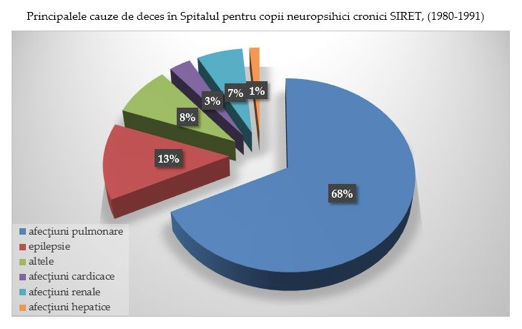
According to IICCMER’s statement released to the editorial, most children died of illnesses that could be treated, and for most of them the deaths were caused by the inhumane way they were treated in the orphanage. A very large number of children have died during winter, most of them due to pneumonia, epilepsy, heart, kidney, and liver diseases.

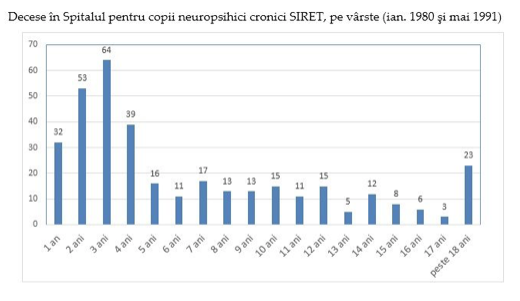
Figure: Deaths in the Siret HCCNC, by age (Jan. 1980 through May 1991)
SOURCE: IICCMER

Most children died when they were between one and four years old. Many of the children admitted to the Siret orphanage were from Suceava County, but also from Bucharest, Bihor, Timiş, Dâmboviţa, Constanţa.

Figure: Evolution of deaths in the Siret HCCNC (1980-1991)

“Following the analysis of death documents and death certificates, carried out by IICCMER experts and by a team of forensic pathologists, we have found that, on the one hand, there were increased mortality rates in the case of easily preventable or early diagnosable and properly treatable pathologies, and, on the other hand, there were deaths that support, by their very nature, our conclusions regarding the existence of a regime characterized by inhumane treatments applied to minors in the hospital.”

309 employees at the hospital-orphanage in 1989

The HCCNC was operating under the Ministry of Health and was headed by a doctor/manager appointed by order of the minister. Since its inception in 1956 until 1991, the hospital has been administered by nine doctors, and the last of them has been running the hospital-orphanage for 24 years.

At the end of the 1980s, the orphanage included 14 specialist doctors, 109 nurses, 115 auxiliary staff, 12 administrative staff, 12 staff runing the school and 47 workers.

There is a legend that hundreds of children were left to die in a field.

Since the establishment of the hospital-orphanage in 1956 until 2001, 1,500 children have died of the total of 8,886 children who have been placed in the Siret institution.

After the death of 81 children in 1981, the number of deaths fell in 1982 and 1983 following the management’s decision to transfer out a very large number of children.

Figure: Main causes of death in the Siret HCCNC (1980-1991)
– Pulmonary affections 68%
– Epilepsy 13%
– Others 8%
– Heart conditions 3%
– Kidney problems 7%
– Liver problems 1%
SOURCE: IICCMER

Among the staff who worked at Siret HCCNC during the communist era there is a legend of an order coming from the Communist Party leadership regarding the fast release from hospital of a large number of patients, an order which was quickly executed at the end of November 1983. The hospital register has recorded the transfer of 750 children over just a few days at the end of November 1983. According to former employees, a large number of these children, especially those with unknown parents, have never reached their transfer destinations, being instead isolated on a field and left to die without being registered.

IICMER states that it could not confirm the information, but it continues the checks.

Criminal complaints to follow for the period 1956-1980

IICCMER said it would file criminal complaints for inhumane treatments for the period 1956-1980, but “given the high volume of work, we can not predict when the actions will materialize,” the Institute’s spokeswoman added.

Last summer, IICCMER has filed another criminal complaint with the Attorney General’s Office for the inhumane treatment of children hospitalized in the Cighid, Păstrăveni and Sighetu Marmaţiei home-hospitals. 771 children have died there from 1973 to 1990. In that case, the prosecutors from the Attorney General’s Office have started in criminal investigations.

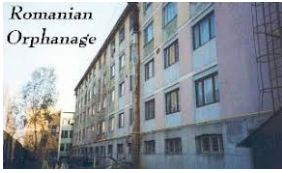
Credit photo: Monitorul de Suceava; photo of the Orphanage Building.

When Love Changes Everything

Screen Shot 2017-08-31 at 10.09.24

Alex Kuch was only eighteen years of age when he spoke at the Romanian Parliament about re-opening International Adoptions from Romania

The love and care of his adoptive parents changed the world for Alex Kuch, but he also gives credit to the University of Auckland, which “opened up so many opportunities” to learn and then to apply the knowledge he has gathered.

Alex Kuch, aged 18 months, with his adoptive parents, Heidi and Walter Kuch.

The story of Alex Kuch, a recent University of Auckland graduate in Politics and International Relations, begins half a world away in an orphanage in Cluj-Napoca, Romania.

Given the basics of life but deprived of any affection, warmth, stimulation or love, Alex suffered from a condition called hospitalisation.

He habitually rocked, had no language and could not make eye contact with another human being.

His life changed forever when his adoptive parents Heidi and Walter Kuch rescued the 18-month-old and gave him a second chance at life in Germany, later relocating to New Zealand when Alex was 11, attracted by our education system.

“When I met Alex he was very quiet,” Walter says, as he recalls the “basic and overcrowded” institution where some 200 children were housed.

“He had a black mark on his cheek. We were told it was from another child who bit him when he tried to pinch an apple. There was not enough for them to eat so they fought over food. Alex couldn’t walk. Nobody cared for him.”

Walter bundled Alex up and took him to Bucharest for three nights while paperwork was finalised, while his new mother Heidi waited anxiously in Germany for their arrival.

“On the first morning in our hotel he woke up and I dressed him and he started rocking. That was a scary moment, it was a symptom of hospitalisation. We didn’t know if he would recover, but regardless I thought ‘he is our child and I will take him home’.”

After a few weeks in a loving home with responsive parents, the rocking stopped and never came back. But the long-term outlook for Alex was grim. A psychologist advised that he would never lead a normal life, complete high school, or have the social skills to integrate into society.

With the help of intensive speech and fine motor therapy, Alex walked at 22 months and began to talk around the age of five.

This year Alex completed a Bachelor of Arts degree and is now an accomplished public speaker, researcher and adoption advocate.

My parents weren’t going to let a prediction determine who I was going to become.

Alex Kuch

“My family is really proud of me, especially as I’m the first person in my family to have gone to university. It has been challenging; however the University has been very supportive. I had a writer for exams as I still have some fine motor challenges such as not being able to write neatly and quickly. But coming to university has opened up so many opportunities for me.”

Alex’s full list of achievements is lengthy and constantly growing. Standouts are speaking twice in Romania’s parliament, the first time when only 18 years old, being named a finalist for Young New Zealander of the Year, and completing research looking at the experiences of adoptees.

He is also an advocate for re-opening Romania’s borders to international adoptions. After the overthrow of the Ceau?escu government in 1989, thousands of abandoned children were adopted by overseas families, but corruption was rife and the world’s attention was drawn to the terrible conditions. Romania closed its borders to international adoptions in 2001.

“Just because there have been bad instances, entire countries have closed international adoptions as a result.

It’s like saying just because a small proportion of a population has inflicted violence towards children then everyone should be prevented from having children. What we need is to develop better policies to protect children during the adoption process.”

To this end, Alex is helping to establish a framework for global adoption policies at the third Asia-Europe Foundation Young Leaders Summit on ethical leadership, and will work with other global adoption experts at the International Conference on Adoption Research in 2020 in Milan.

Alex Kuch, photographed recently with Frank- Walter Steinmeier, President of Germany.

He will also share his joint research with Dr Rhoda Scherman from AUT, which compiles the experiences of other adoptees published on the New Zealand based ‘I’m Adopted’ website.

“I’m Adopted is a place where adoptees from around the world can connect and share their stories,” says Alex. “With the permission of the adoptees, we have gone through dozens of stories to pull together the common themes of what adopted children go through. It’s valuable knowledge for agencies and families, for example knowing when to intervene or what to expect, and to provide better support.”

In an unusual twist in Alex’s own story, he met his birth mother three years ago on a live Romanian talk show.

Alex has visited Romania twice to advocate for reopening international adoptions, but has never sought to connect with his birth parents. While he was speaking on television about his advocacy work, the show’s producers blindsided him by bringing his birth mother and half siblings onto the stage.

“It could have been done more professionally, but things are a bit different over there,” Alex says.

“After I visited some orphanages and was then surprised by my biological family, I began to recall some visual impressions of my time in my orphanage. It was very emotional.”

Alex has chosen not to stay in contact with his birth mother.

“Why would I? I have a mother and father in New Zealand,” he says.

Heidi, his adoptive mother, says there was never an expectation that Alex would attend university. His younger brother Colin, also adopted from Romania two years after Alex, is more hands-on and has started a building apprenticeship.

“Alex just loves to learn. Once he learnt to talk, whoosh, it was like a waterfall that never stopped. He was always asking questions,” Heidi says.

“But we never put pressure on him to go to university. We just supported him in whatever he wanted to do. We didn’t spoil the boys or give them lots of toys, but we spent lots of precious time with them playing games and doing activities as a family.”

But Heidi says Alex was a challenging student and the German schooling system held him back.

“The New Zealand school system has been very good for Alex. When they discovered he was good at maths they pushed him, and then he was away.”

Alex was a top student at KingsWay School, on the Hibiscus Coast where he grew up.

Now back living in Europe, he has begun an internship with children’s rights and development organisation, Aflatoun International, based in the Netherlands. He also plans to return to Romania to continue to advocate for the re-opening of international adoptions, and is writing an autobiography chronicling his journey from the orphanage to New Zealand.

“Alex’s background, interests and experience will help us to scale up our focus on children that are living in alternative care and will have to stand on their own feet as they reach the age of 18,” says Roeland Monasch, director of Aflatoun International. “We want to make sure this specific group of children are empowered with these essential social and financial skills in order for them to be resilient and successful in their adult life. Alex will be a great resource for us.”

By Danelle Clayton  

#love

Ingenio: Spring 2018

This article appears in the Spring 2018 edition of Ingenio, the print magazine for alumni and friends of the University of Auckland.

Half a Million Kids Survived Romania’s Slaughterhouses of Souls- Now They Want Justice

Dec.28th. 2015. Global Post by Vlad Obelescu

https://www.pri.org/stories/2015-12-28/half-million-kids-survived-romanias-slaughterhouses-souls-now-they-want-justice


Nicolae and Elena Ceauşescu in the midst of children and youth who addressed New Year 1978 wishes to party and state leaders. (30.XII.1977)

[Photo #BA225] Online Communism Photo Collection.

Romania’s Lost Generation- Inside the Iron Curtain’s Orphanages


Girls eating lunch at a Romanian Orphanage. Photo courtesy of Tom Szalay.

http://www.abc.net.au/radionational/programs/allinthemind/inside-the-iron-curtain’s-orphanages/5543388


Romania’s Last Orphanages

http://www.hopeandhomes.org/news-article/economist-film/

@TheEconomist has visited @HopeandHomes projects in Romania to create a film examining how we’re finding families for the 7,000 children who remain in ‘Romania’s Last Orphanages’ https://buff.ly/2nn16YQ #FamiliesNotOrphanages

HOPEANDHOMES.ORG
Hard hitting film by the The Economist exploring the rise of the terrible orphanage system in Romania and explaining why Hope and Homes for Children is determined ‘Romania’s Last Orphanage’ should close.

Hope and Homes for Children’s work in Romania is central to a hard-hitting new film, released today by The Economist.

Available here. ‘The End of Orphanages?’ focuses on the transformation that’s taken place in Romania’s child protection system in recent decades.

Viewers are reminded of the horror of the Ceausescu-era orphanages that were discovered after the fall of the dictator in 1989 and goes on to explain how the majority of the county’s orphanages have now been closed by ensuring that children can grow up in family-based care instead.

Hope and Homes for Children has played a fundamental part in driving the process of child protection reform in Romania over the last 20 years. When we began work there in 1998, over 100,000 children were confined to institutions. Today that figure has fallen by more than 90% to less than 7,200.

The Economist film tells the story of Claudia, a woman in her late 30s who was born with one arm and abandoned to the orphanage system as a baby. She shares painful memories of the abuse and neglect she suffered as a child. She struggles to remain composed as she describes one incident where she was stripped and beaten with a rope as a punishment for playing in the wrong place.

“Effectively we belonged to no one. You were basically treated like an animal” she says.

Today Claudia works in the Ion Holban institution in Iasi County – one of the remaining orphanages that Hope and Homes for Children is working to close in Romania. The film shows some of the children who have already been supported to leave the institution and join families.

The Manole sisters spent five years in Ion Holban after their remaining parent died. Our team gave their extended family the extra support they needed to make it possible for all four girls to leave the orphanage and begin a new life together with their Aunt and Uncle.

Stefan Darabus, our Regional Director for Central and Southern Europe, contributes to the new film, explaining “Any institution like Ion Holban should be closed. They do not offer family love. They do not offer what a child needs most which is to belong to a family, to have a mother and a father, to feel special.”

The film gives a balanced view of the process of deinstitutionalisation, pointing out the risks to children if the process is not properly supported but gives the last word on the future of the children in the Ion Holban to Claudia. “What they need is such a simple thing,” she says. “Parental love in the bosom of the family, rather than in the bosom of the State. But mainly they need to be accepted.”

E.U. Funds Used to Close Fifty Orphanages in Romania

access antique bolt close
Photo by Pixabay on Pexels.com

EU funds will be used to close 50 Romanian orphanages

The Government of Romania has confirmed that it will use European Union funds to close 50 state orphanages and other residential institutions for children. The closures programmes will take place across the country, in seven out of eight regions, and include institutions for children with disabilities.

As part of Opening Doors for Europe’s Children, our pan-European campaign with Eurochild, Hope and Homes for Children has played a key role in securing EU funding for child protection reform across Europe and ensuring that the money is specifically ring-fenced for closing institutions and supporting families.

Adrian Oros, National coordinator of Opening Doors in Romania said, “This is an important step in the reform of the child protection system in Romania. The long-standing governmental declarations to close all institutions by 2022 are getting gradually translated into action. Especially commendable is the fact that a third of the old-type institutions in Romania that have been listed for closure by the Government in May 2017 include institutions for children with disabilities. This group of children make up almost 60% of all the children who remain in Romanian institutions. The time to ensure their right to live in more inclusive, supportive and caring communities is now.”

Although Romania has made great progress in reforming its child protection systems over recent decades, there are still 7,500 children living in the 191 remaining institutions. Johnny is one of these children. He loves football and being outside but he spends most of his time indoors because he uses a wheelchair and the orphanage where he lives has few ramps and no lifts. Johnny was separated from his younger brother and his father when his mother died and his family could no longer care for him without support.

Screen Shot 2017-12-09 at 15.44.02Hope and Homes for Children is working to close the institution where Johnny lives by finding safe and loving family-based care for all the children living there. The news that EU funding is now available to support this and 49 other closure programmes marks a significant step towards the day when all children in Romania can grow up in families and not in orphanages.

Hope and Homes For Children; Romania. Deinstitutionalisation

In 2018, almost 6,500 children in Romania still live in institutions, which are inappropriate for their development.

Reports of sexual abuse, physical abuse, emotional abuse, child-trafficking and suicide, consistently appear in the media regarding the abandoned children in these institutions.

Over the past twenty years, Hope and Homes for Children, Romania, has closed 56 institutions, including the Nassau Foster Centre, and built and moved institutionalised children to one hundred and four family type homes.

http://www.hopeandhomes.org/news-article/mark-and-caroline-romania-honours/


Concepte Actuale de Identitate Invechit- de Alex Kuch

man in black hoodie sitting on brown couch
Photo by cottonbro on Pexels.com

Concepte actuale de identitate Invechit- de Alex Kuch

Concepte actuale de identitate neactualizat, de Alex Kuch

Adoptarea este un proces complex și una dintre provocările cele mai complexe în jurul adopțiilor este identitatea unui individ. Idei în jurul identității în adopțiilor au o varietate de puncte de vedere, chiar și instituții internaționale recunoscute, o astfel de UNICEF și Organizația Națiunilor Unite au luat pe opinii în care sugerează că, în special identitatea este limitată la locul geografic al nașterii unui individ, prin urmare, în (Declarația din drepturile copilului, 1959). Prin urmare, aceste organizații în ansamblu a ales să interpreteze toate cele 10 de articole, acei copii care au nevoie să rămână în țara lor de naștere. Ei consideră identitatea ca un concept static, în timp ce identitatea este construită social și este format de către individ și interacțiunile cu alte persoane a lungul timpului.

Această socio – autobiografie va analiza modul în care conceptele de identitate în special în căutarea sinelui de sticlă, ME și eu și racializing și modul in care fortele sociale mi-au modelat pentru a fi persoana care sunt acum si va investiga importanța sociologică a conceptelor.

Charles Horton a venit în lucrarea sa (Cooley, 1902) cu conceptul de sticlă auto în căutarea. Acesta conține trei concepte cheie; ne imaginăm cum se pare o altă persoană. Am la un nivel personal se poate referi cu siguranță la faptul că, mai ales din cauza romilor meu sau informal cunoscut sub numele de etnie țigănească, ceea ce îmi dă un ton mai inchisa a pielii. Ca urmare a acestui fapt îmi imaginez că cei mai mulți oameni care mă văd prima dată că, din cauza aspectului meu va crede că eu sunt de la una din următoarele țări, Orientul Mijlociu, India, Mexic sau Spania sau alte țări care sunt considerate a fi tonul pielii ofmy. Acest lucru este sprijinit în diferite cele mai noi cercetători, cum ar fi (Perkins, K, 2014), modul în care primul și al doilea imigranți simțit în Statele Unite.

De asemenea, ne imaginăm modul în care alții judeca aspectul cele. Toată lumea face acest lucru și mai ales cei care sunt marginalizați în societate. Acest lucru se întâmplă între diferitele culturi și de ori.

Eu personal am experimentat modul în care mi-am imaginat alții m-ar judeca, după ce a fost la televiziunea națională română și vorbesc despre povestea vieții mele și iertător mama biologică pentru mine abandonarea. M-am așteptat să fie șocat despre comportamentul meu pentru că am comportat într-un mod care a fost contra-cultură. Studii (Tice, D, 1992) au arătat că un comportament în public a avut un efect asupra modului greater- o imaginează sine și anticiparea unor viitoare întâlniri publice a crescut interiorizarea. Acest lucru cu siguranță a fost cazul pentru mine.

Dar nu am imagina că oamenii ar găsi în loc, de asemenea, o formă de confort în acțiunile mele, în special cei care au abandonat copiii lor și le-a dat la orfelinate, au existat numeroase cazuri în care persoanele în vârstă, în public exprimat acest lucru pentru mine. În cercetare, sa demonstrat că modul în care alții sunt vizualizate și efecte cum se simt cu privire la această hotărâre percepută (Shrauger, J, 1979) & (Aken, M, 1996) judecat.

De asemenea, ca urmare a hotărârii percepute afectează felul în care se simte despre ei înșiși, eu cu siguranță pot spune că m-am simțit copleșită de modul în care ma judeca oamenii din România într-un mod pozitiv și într-o oarecare măsură, chiar mi-a dat celebritate / statutul sfânt , cum ar fi oamenii cer să vorbească cu mine în public și cu o fotografie făcută cu mine. După cum sa menționat mai sus, studiile confirmă faptul că interacțiunea mai publică și anticiparea acest lucru crește interiorizarea, prin urmare, aceasta crește, de asemenea, modul în care s-ar simți hotărârea percepută (Tice, D, 1992)

Aceste tipuri de evenimente nu se întâmplă doar pentru mine ca individ, ci se întâmplă cu alte persoane, precum și care au fost în situații similare, în ciuda fiind influențate de diferite forțe sociale și diferite perioade de timp.

Conceptul de sticlă în căutarea auto-are o importanță sociologică enormă, mai ales în exemplul meu cum se simt adoptees despre ei înșiși, ca urmare a hotărârii percepute altora, prin urmare, un argument foarte de bază se poate face ca societatea ar trebui să fie informați cu privire la adopții și modul în care oamenii mai ales ar trebui să fie vorbit pentru toate părțile implicate și modul în care aceasta poate afecta și de a face oamenii se simt. Un studiu foarte recent (Eriksson, P, 2015) arată că părinții adoptivi sunt foarte mulțumiți de educație pre-adopție și în timp ce adoptarea a avut loc și este un proces foarte important.

George Herbert Mead în (Mead, G, 1982) a venit cu conceptele de mine și I, „I“ este o persoană care face parte independentă care opereaza inainte de un individ este conștient de faptul că există lumea din afara propriei lor de sine. „Eu“ este ca urmare a influenței altor persoane în societate.

Pentru mine personal am început să fie conștienți de faptul că există lumea din afara propriei mele de sine, la vârsta de 4 ani. Cercetare (Bloch, H, 1990) arată că acest lucru se întâmplă la vârsta este de 2 ani, dar începe de la vârsta persoanei se naște până la vârsta de 5 ani. Cu toate acestea (Cooley, 1902) susține că indivizii imagina cum lor de auto-aspect este judecat de către alții, dar acest lucru în mod clar nu este cazul pentru copii sub vârsta de 2, dar varys desigur si nu imagina cum este judecat aspectul lor și prin urmare, nu au un sentiment perceput de această hotărâre. Acest lucru poate fi văzut în mod clar de către copiii mici, deoarece, în general, pe cont propriu ei nu judeca unii pe alții și nu se simt judecat. Eu personal pot spune că la vârsta înainte de unul este conștient de lumea exterioară de sine lor. Cu toate acestea, după vârsta de 2 Me într-un individ ca (Mead, G, 1982) prevede este un rezultat al influențelor altor oameni în societate. Eu personal cu siguranță pot spune că pentru mine am fost mai mult influențat de familie și prieteni apropiați mai în vârstă am. Acest lucru este confirmat și de (Cooley, 1902) că, ne imaginăm cum alții vedea, judeca aspectul cuiva și, ca urmare au un sentiment perceput despre judecata făcută pe o persoană.

Rasializarea este o practică comună și noi toți au experimentat-o ​​și a făcut-o noi înșine. (Matthewman, S, 2013) definește rasializarea ca fiind „procesul prin care idei și credințe despre rasa, impreuna cu clasa si sex, forma relațiilor sociale; cu alte cuvinte, construcția socială a rasei.“Sau (Matthewman, S, 2013) definește rasializare ca„un proces social prin care „un grup este clasificat ca fiind o rasă și definită ca o problemă“

Am de multe ori cu experiență rasializarea mai ales că oamenii judecă cel mai adesea în cazul în care sunt de aspectul meu fizic și oamenii sunt cu adevărat șocat când le spun că sunt din Europa și adoptat de România de către părinți germani. Există aceste diferențe în ceea ce privește rasa si origine etnica.

.

Rasă Etnie
Moștenit – fizică Învățate – Social
Științific Subiectiv
Văzut Simțit
Proiectat Ales
Clasificare Identitate
Fix Fluid
Colonialism Post-colonialismului

Tabelul de mai sus prezintă câteva diferențe esențiale între rasă și etnie.

O caracteristică generală cheie este faptul că etnia este fluid și dinamic; Cu toate acestea, o mulțime de organizații internaționale susțin că o adopție internațională (adopțiile internaționale) daune identității adoptatului lui. Cu toate acestea, identitatea unei persoane nu depinde de țara de naștere, ci un factor, cum ar fi ceea ce a învățat în creștere și identitatea unei persoane se schimbă continuu și în curs de dezvoltare în timpul vieții lor.

Chiar și oamenii pot avea mai multe sau chiar un mix etniile, prin urmare, pot să mă numesc un român, german, neozeelandezul (kiwi) și până de curând în acest an nu ar lua în considerare România una dintre etniile mele, dar evenimente dramatice, cum ar fi sa se confrunte cu familia biologică dar chiar și mai inspectează orfelinate și aziluri mi-a dat o mai mare înțelegere în trecutul românesc și prezent și în formă de identitatea mea personală.

Conceptul de racializing are o importanță imensă sociologică pentru că noi toți judecăm pe alții de numeroși factori, cum ar fi etnia, credințele religioase și aspectul. Ca urmare a acestei anumite percepții iau în evidență și să dea naștere la putere a oamenilor se afirmă în detrimentul altora. Un exemplu în acest sens pentru mine a fost că, atunci când am fost adoptat, un unchi a spus „Voi adopta Alex, cum nu știi că el nu va deveni un hoț / criminal“, care a fost rasializarea pentru că am fost din România și va fi adoptat , care a avut și are încă un stigmat rău în ceea ce privește crima. În ciuda faptului că eu fost în România de mai multe ori în diferite părți, nu am mai experimentat nici o crimă și a fost tratat cu cel mai mare respect.

Prin urmare, în rezumat identitate este un concept complex, mai ales în Adopții. Cu toate acestea, argumentele de la instituții, cum ar fi Organizația Națiunilor Unite și în special UNICEF, care daune adopțiile internaționale cauze la identitate ca urmare a unei persoane părăsesc țara de naștere este un punct bazat foarte rasial de vedere și a identității ca puncte de vedere fixe. Cu toate acestea identitatea constau în mult mai mult, cum ar fi discutat mai devreme Me și eu, sinele individuale și influența sinelui de către societate. Looking Conceptul de sticlă de sine în cazul în care punctele de vedere, percepția și judecățile altora afectează căile unui individ se raportează la el sau ea.

Ceva ce ar fi bine pentru a investiga ar fi pentru aceste organizații să facă mai multe cercetări calitative și cantitative în modul în care, de fapt, în instituțiile mele orfelinate de caz, efecte de copii sau să se uite la cercetare existente, deoarece acestea nu sunt soluții permanente pentru copii pe termen lung.

Pe lângă faptul că rasializarea este foarte critică și aceste instituții susțin adesea că anumite etnii sunt mai problematice decât altele, dar nu este etniile, dar modul în care indivizii au fost tratate; prin urmare, experiențele lor personale, care formează identitatea lor, care de multe ori au fost de natură psihologică și fizică.

Prin urmare, în general pentru mine identitatea mea a fost afectată de adopție, dar și-a extins experiențele mele personale și de fapt îmi permite să interacționeze mai bine cu oameni de diferite etnii, din cauza gama mea de experiențe.

numărul de cuvinte: 1619 

Referințe 

Aken, M., Lieshout, A., & Haselager, G. (1996). Competența adolescenților și reciprocitatea de auto-descrieri și descrieri ale acestora furnizate de către alții. Jurnalul Tineretului și Adolescence,  25 (3), 285-306.

Bloch, H. & Bertenthal, BI (1990). Senzitivomotor Organizații și Dezvoltare în pruncie și timpurii Proceedings din copilarie de cercetare NATO avansată Atelier de lucru pe senzitivomotor Organizații și dezvoltare în fază incipientă și timpurie copilarie Chateu de Rosey, Franța  (seria NATO ASI Seria D, comportamentale și științe sociale;. 56) . Dordrecht: Springer Olanda.

Cooley, & Aut. (1922). Natura umană și ordinea socială .

Eriksson, P., Elovainio, M., Mäkipää, S., Raaska, H., Sinkkonen, J., & Lapinleimu, H. (2015). Satisfacția părinților adoptivi finlandezi cu statutară consiliere pre-adoptare în adopțiile internaționale. Jurnalul European de Asistență Socială,  18(3), 412-429.

Matthewman, S., Vest-Newman, Catherine Lane, & Curtis, Bruce. (2013). Fiind sociologică  (2nd ed.). Basingstoke: Palgrave Macmillan.

Mead, G., & Miller, David L. (1982). Individul și sinele social: opera lui George Herbert nepublicata Mead . Chicago: University of Chicago Press.

Perkins, K., Wiley, S., Deaux, K., & Zárate, Michael A. (2014). Prin care Looking Glass? Surse Distinct de respect public si respectul de sine Printre Imigranti primul si a doua generație de culoare. Diversitatea culturală și etnică Psihologie minoritare,  20 (2), 213-219

Shrauger, J., Schoeneman, T., & Hernstein, R . J. (1979). Vedere interacționistă simbolică a conceptului de sine: prin oglindă întunecat. Psychological Bulletin, 86 (3), 549-573.

Tice, D., & Miller, Norman. (1992). Auto-Concept Schimbarea și auto-prezentare: Looking Glass Sinele este de asemenea o lupa. Jurnalul de Personalitate și Psihologie Socială,  63 (3), 435-451.

Adunarea Generală a Organizației Națiunilor Unite  Sesiunea 14  Rezoluția  1386Declarația drepturilor copilului A / RES / 1386 (XIV)  20 noiembrie 1959. Adus de 2015-10-29.

Mesaj de navigare

Blue Heron Foundation; Scholarships for Orphaned and Abandoned Romanian and Moldovan Youth

Blue Heron Foundation; Breaking the Cycle of Poverty.

Blue Heron’s Foundation mission is to improve the quality of life for orphaned and abandoned  institutionalized youth in Romania and Moldova by providing them with Scholarships for a College education.

In the past twenty years, the Foundation has successfully helped three hundred and fifty students achieve their dream of a College education.

The enrolment period for scholarships is- 1st. May- 31st. August.

Blue Herron Foundation covers – Tuition fees.

Provides a monthly amount of money for personal expenses.

Provides access to a mentoring program.

Free participation in the Summer Camp.

http://www.blueheronfoundation.org.                                                                                Florin with his Bachelors in Marketing and Management.

Since 2002 the Blue Heron Foundation has dedicated its efforts to improving the quality of life of Romania’s orphaned and abandoned children by providing them with greater access to life’s opportunities. The organization awards them scholarships, training courses, mentors and counselling throughout their collage years. 100% of the donations go directly to the project as the founders cover all organizational expenses.

R. Todd Updegraff.